برچسب: Transparency

  • Publication of financial statements of state-owned companies is a step to increase performance and productivity

    Publication of financial statements of state-owned companies is a step to increase performance and productivity


    Reza Nowrozian, in an interview with Fars news agency’s economic reporter, emphasized the necessity of transparent data on the performance of state-owned companies and stated: The existence of transparent information data helps the correct operation and brings decisions closer to the goals, since the time of the revolution until recently, when the subject of tax statements State companies have been operationalized, there was no public access to the financial statements of the companies, and in the reports there were only references to the performances, profits and losses.

    He added: Fortunately, with the initiative and proposal of the Ministry of Economy, a clear picture of the performance of government companies is presented in the form of financial statements, and the profit and loss of the financial statements is published publicly in the form of a comparison with itself or other companies, or in the form of annual reports. and its use and review will be useful for public and economic companies and will bring decisions closer to reality.

    The Deputy Director General of State Enterprise Affairs of the Ministry of Economy continued: It is important that the publication of the financial statements of state companies alone does not lead to an increase in productivity, but it can be said that the publication of the financial statements of state companies is the first and most important step of the government towards the transparency of the performance of these companies, which lays the groundwork. It will increase public awareness and allow for higher productivity. Therefore, the public release of financial statements is a big step that will create transparency and improve the performance and productivity of government companies.

    He discussed the effect of increasing transparency on the productivity of state-owned companies and added: In the financial statements, the performance of the companies can be monitored in a macro view and the amount of income and expenses compared to before can be checked and a correct analysis of the weak and strong points can be obtained. Most of the information needed to calculate the productivity of state-owned companies can be extracted from the financial statements of the companies, while a series of performance information is also needed to calculate the productivity of the companies, which are not included in the financial statements and are available with the satisfaction of the performance reports.

    Criticizing the ambiguities in the definition of company productivity, Noroozian said: the meaning of company productivity is used a lot in the literature of state companies recently, it is not clear and there is no precise definition in this regard, every year a forecasted plan and budget is provided to each company that moves It directs companies, so the definition of productivity should include different angles, but the release of information in the form of financial statements includes a major part of the basis and context of productivity, which is the primary feed of productivity.

    He considered it necessary to prepare reports such as the book “Looking at the performance of state-owned companies” and added: “Printing and publishing the book means that the company is in a position of accountability and its priority is to cover possible weaknesses.” The book “Looking at the performance of state-owned companies” is the first book to be printed and published with this content, and we do not claim that it is perfect, but we believe it is a valuable collection for company building; What has been prepared and produced under the title of the book is the extraction of the most important headlines and financial figures of the companies in a comparative way, and the most messages are provided to the users through the headlines.

    According to Fars, one of the most important issues in the field of economic policy is the existence of transparent data and a clear picture of the performance of important economic sectors.

    One of these important economic sectors are state-owned companies. Until a year or two ago, access to the audited financial statements of state-owned companies was so difficult that even parliamentarians had no way to access this information except by directly following up with the ministers and heads of independent government organizations. The situation changed when the 13th government came into office, and the transparency of the performance of state-owned companies was put on the agenda through the public release of their financial statements, and this issue became one of the first promises of the Minister of Economic Affairs and Finance.

    Also, in addition to the publication of financial statements in the Kodal system, there is a vacancy for reports that use financial statements to investigate the performance of these companies in recent years and also to compare them; It was also felt strongly. The preparation and publication of the book “Looking at the performance of state-owned companies” by the Office of State-owned Companies of the Ministry of Economic Affairs and Finance is an attempt to fill this gap and is a help for a better and simpler understanding of the plan of financial statements and to present a picture of the performance of state-owned companies that was recently published. has been

    end of message/


    Suggest this article for the first page

  • Investigating the promotion of health and transparency in the judicial system

    Investigating the promotion of health and transparency in the judicial system


    According to the report of Fars news agency’s judicial group, citing the judiciary, this morning, Wednesday, April 30, a meeting of the Supreme Leader’s Supreme Leader’s orders was held in the judiciary, with the presence of the first deputy of the judiciary and other high-ranking officials of the judiciary.

    Hojjat al-Salam wal-Muslimin Mohammad Mosadegh stated that today’s meeting is the second meeting in 1402 and the 16th meeting of the entire headquarters following the orders of the Supreme Leader in the judiciary and said: “One of the very important issues raised in the orders of the leader of the revolution in the judiciary.” The aim was to eliminate corrupt structures and fight corruption in the country.

    The First Vice President of the Judiciary stated that this point is very important and is emphasized by the Supreme Leader and the Head of the Judiciary, and clarified: We must anticipate operational solutions for this issue and the issue of midwifery is related to corruption outside the judicial system. And it should be studied and bottlenecks of corruption should be identified and dealt with.

    Hojjat al-Islam wa al-Muslimin Mossadegh, referring to the completion and improvement of the judicial transformation document, stated: The judicial transformation document is being upgraded and should be worked on, therefore, in today’s meeting, the representatives and officials who are working on the document are invited We made them attend the meeting.

    end of message/

    He added: In the field of identifying the bottlenecks of corruption, the General Inspection Organization of the country has conducted a comprehensive and complete study and investigation, which will be taken into account, and within the judiciary, it should be done in a way that maximum transparency, health, and efficiency are applied.
    The first vice president of the Judiciary stated: The structure should be upgraded in such a way that the creation of corruption will be reduced.
    He added: The main task of the headquarters for the implementation of Supreme Leader’s orders in the judiciary is to make demands from the custodians of the judicial reform document and to focus on the Supreme Leader’s 8 orders.
    Hojat-ul-Islam Mosaddeq said: We must give appropriate plans and strategies for this camp so that by implementing those plans, we can achieve the necessary results to advance the goals of the Judiciary.

    In the continuation of the business meeting, the strategic deputy of the Judiciary explained the details of the actions taken by the headquarters to follow up on the orders of the Supreme Leader in the Judiciary, regarding his second order regarding action strategies regarding the identification and combating of corruption.

    In the continuation of this meeting, Hojjat al-Islam Mortazavi Moghadam; President of the Supreme Court, Hojjat al-Islam Abdulahi; Head of Sarmi Judiciary Protection and Information Center; Head of Judiciary Directorate, Kazemi Fard; Vice President of Statistics and Information Technology of the Judiciary, Hojatul Islam Ebrahimi; Head of the Judicial Development Document Follow-up Center, Jamshidi; A member of the Steering Committee for the implementation of the country’s judicial transformation document expressed their opinions, suggestions and criticisms of the issues raised in this regard.

    end of message/


    Suggest this article for the first page

  • The establishment of the Bank of Talents Treasury in Tehran Municipality/ the process of obtaining the license of electronic service offices is facilitated

    The establishment of the Bank of Talents Treasury in Tehran Municipality/ the process of obtaining the license of electronic service offices is facilitated


    Fars News Agency, Shahri Group: The elections of the 6th city and village council were held on June 28 last year. This election coincided with the presidential election and the people of Tehran voted decisively for the list of the Islamic Revolution Coalition Council and the activities of 21 people in the list. The activities of the 6th city council in the capital city started almost from the middle of August last year, and their most important priority, which was the election of the mayor, was also carried out.

    In their second session, the members of the 6th council elected “Alireza Zakani” as the mayor of Tehran with 18 votes out of 21 votes. After a month, Alireza Zakani’s sentence was announced by the Minister of Interior Dolat Raisi and he officially started his work in Tehran Municipality on 11th of Shahrivar. Now one year has passed since the activity of urban management and during this period urban management has entered in different areas and changes have been formed in the municipality in the form of administrative transformation.

    About various issues in the field of modernization and administrative transformation of Tehran municipality, including changing the structure, organization and missions of the municipality, transparency system, creating a QR code for all municipal employees, changing the bylaws of the electronic service offices, modifying the procedures in the Article 100 Commission, the National Permits Portal, etc. . With Mohammad Ali Alfatpour, head of Tehran Municipality’s Administrative Transformation and Modernization Center We had a discussion, the details of which are as follows:

    What are the most important programs and priorities in the center of renovation and administrative transformation of Tehran municipality?

    About a year and a few months have passed since the establishment of the Tehran Municipality Administrative Transformation and Renovation Center, and I have been working in this organization for about eight months. The main work and programs in this organization is the discussion of process improvement. According to Alireza Zakani, the mayor of Tehran, the main need of the city is to correct the processes in the municipality in order to provide services to the citizens quickly and accurately. Therefore, reforming the processes in this organization is on the agenda as a priority.

    4 main priorities of Tehran municipality/the story of the popularization project of the city administration

    What is the story of the popularization plan of the city administration and what programs are going to be implemented in Tehran municipality in this field?

    You see, in general, one of the main priorities of Tehran Municipality is smartening, sustainable financing, popularization and the use of national capacities. do We have talked with many experts, a conference was held in this field, and the specialized vice-chairs at five levels have investigated this matter. Now we have special plans for people’s participation in urban affairs, which will be implemented in the coming months.

    Identification of one hundred bottlenecks of corruption and systemic inefficiency

    How is the reform of the structure and processes considered in order to fight corruption in the municipality?

    We have started actions with research and academic centers to improve the structure, processes and transparency. Based on this, we considered more than one hundred bottlenecks that can cause corruption and system inefficiency, such as the issue of issuing a license, because the issue of issuing a license is one of the most important issues and processes that, if not paid special attention to, can also cause corruption. It also creates too much discretionary authority for decisions, for example, there are about 129 steps for the issue of licensing, which we are reducing logically to below 70 steps. Currently, it takes more than 360 days to issue a license, and we have been trying to eliminate about 60 to 70 arbitrary steps to avoid delaying time and forming golden signatures. Most of these works will be done by the end of this year, and the issuance of permits will take from one year to two months.

    In the case of Article 100 and Article 5 commissions, mechanisms are being prepared with the cooperation of the private and public sectors, and this issue is also in our priority for reform. There are many cases left in the Article 100 Commission, and with the increase of the branches of this commission, we can witness the acceleration and facilitation of serving and processing people’s cases. A plan for this matter is being prepared in the parliament, but we have also entered into the discussion of the structure of these offices in order to provide better services. Also, the modification of procedures and processes within Tehran municipality, such as the modification of waste mechanisms, has also been considered.

    We have changed the regulations of the electronic service offices/the regulations will be unveiled soon

    It is said that the regulations of electronic service offices are changing, tell us about the details of these changes.

    We have changed the bylaws of electronic service offices and the new bylaws will be unveiled soon. Activity in electronic service offices should not create a monopoly, therefore, in order to increase the issuance of licenses for the operation of these offices, we have facilitated the conditions in terms of reality and law. Now there are about one hundred electronic service offices in Tehran, and their number should be increased.

    The mechanism of the processes should be modified and the expert should not have much contact with the client. In other words, documents should be delivered and other mechanisms should be done electronically. Currently, the annual income of one hundred electronic service offices of the city is about 3 thousand billion tomans, which is a small part of the income of these offices for the municipality, and much more than 3 thousand billion tomans goes out of people’s pockets through brokers, and issues such as bribery and… It is considered in the name of the municipality that corruption and abuse will be prevented by making the processes electronic.

    77 titles and 51 headings in the transparency system

    What is the news about the transparency system and how have the plans progressed?

    The transparency system is the focus of the administrative transformation and modernization center of Tehran Municipality. The transparency site did not have a specific trustee before. 77 titles and 51 chapters that have legal approval will be updated in the coming months. Of course, 30 indicators have been updated in the new period. There are also differences on some issues, especially the publication of information related to people’s privacy, and we must reach an understanding in this regard.

    Setting up the national license portal

    Where did the establishment of the national license portal go and how many businesses does the municipality license?

    You see, the Ministry of Security has been pursuing the establishment of the national license portal in the municipality for more than three years before the new era, and Tehran Municipality has now started serious planning to issue licenses to 22 businesses in various fields, and soon they will implement these licenses based on the standards of the Ministry of Economy. Issuing licenses for businesses from car food to kindergartens… is now issued by Tehran municipality and these licenses are first electronic in the municipality and then it will be connected to the national license portal.

    Integration of data and information in the financial and economic field

    How have the strategies and programs for transformation been implemented in the financial and economic field?

    We had a lack of data and information integration in the financial and economic fields. We prepared and followed up a plan that we are in the final stage of. Accordingly, from the request to the issuance of the check, everything is monitored and implemented in one mechanism, and this matter is completed by the evaluation headquarters, for example, at what stage is a project, how much budget has been allocated for it, how much physical progress has been made, and how much budget and credit have been spent so far A project has been realized and all these issues have a serious and effective effect in preventing corruption, speeding up operations and facilitating service delivery.

    Launching of Tehran Municipal Process Bank

    We have also set up a bank of municipal processes and identified 1093 processes for integration and electronicization. 70% of people’s referrals in municipal areas are done in 5 main processes, each of the 22 districts of Tehran, unfortunately, are doing it with the same model, which we have integrated all of them and now we have announced that they will proceed according to the single mechanism of the programs.

    Design of urban service desk and cart

    The city service desk and cart table have also been designed, based on this, when citizens submit their documents, they can see in the service desk system what stage their case is at and they can follow up on the necessary restrictions.

    QR system in the municipality for reporting from all employees

    It is said that the QR system in the municipality was designed to report from all employees, how are the details of this plan?

    We have designed the QR system for all the forces and human resources of the municipality. Currently, 12,000 to 13,000 employees of the municipality are going to receive a QR code, and we designed it in such a way that this code will be installed next to the entrance door of all the employees. Accordingly, citizens can scan this code and inform us of reports, criticisms, suggestions, encouragements, etc., and we will review and analyze public reports, and if there is a violation or deficiency, the inspection organization will enter and Hopefully it will be fixed.

    We considered the Qr code for bus drivers, taxi drivers, all parks and even lampposts in the next phase, for example, if people are unhappy and have a complaint, they can inform us through this code.

    A new plan for the appointment of managers

    What new plan has been considered for the appointment of managers and what is the story of the creation of the Bank of Talents?

    In the field of selecting managers, we also considered serious programs for evaluation and assessment. Based on this, we selected 795 appointed managers in Tehran Municipality through the evaluation center. If in some cases people were nominated to be selected as managers, they were evaluated in this committee, and the cases that could not get the votes of the committee members were rejected.

    Establishing the Bank of Talents Treasury in Tehran Municipality

    We have plans in the administrative modernization and transformation center to identify 2,000 people in Tehran municipality as top talents and after a specialized test, form a talent bank and plan accordingly for the promotion and better employment of these people. .

    In Tehran Municipality, we have 60,000 official and direct personnel and 40,000 volume and contract personnel, which is a total of about 100,000 personnel. We intend to use the forces more optimally. There is no basis for adjustment, but in any case, the employees’ salaries are paid from the people’s pockets, and the troops must have certain acceptable activities and work per 8 hours of presence in the municipality, so we have serious plans to improve the efficiency of human resources.

    On the other hand, in some municipal organizations and complexes, it has been announced that there is a shortage of personnel, and we must compensate for these shortages by increasing personnel in other departments. According to global standards, for example, in the city of Istanbul, there are 40,000 direct and volume workers in the municipality, while this city also provides tourism services, but we have three times as many workers in Tehran. For some European countries, the average standard of municipal forces is 11,000 to 14,000 people, so we intend to have serious plans for the optimal use of employees.

    More than 96% of the managers are among the municipal employees

    In some periods, we have recruited an average of 6.5 people daily in the municipality, but in the new city administration, not even 100 people were employed in different formats, and most of the appointments were made by the municipality itself. In the new management appointments, more than 96% of the fourth and fifth level managers were among the municipal employees with high educational degrees.

    The main factor behind the recent hack of the municipality

    Recently, the mayor of Tehran has announced the launch of several systems in the municipality. What sectors are these systems for, and is non-active defense planned for them?

    We have about 20 systems in the modernization center that we are following up for launch. Detailed follow-ups are being done in this field as well, and for example, we have started special works in the field of municipal document management. We carry out work for the electronicization of missions, and the issues of safety or defense or reducing cyber risks are the responsibility of organizations such as the Municipal Information Technology Organization and other cyber and security institutions of the country.

    The infrastructure architecture in the municipal information technology organization is old, and this architecture has not been strengthened and updated for maybe 10 years, and it was the main cause of the recent hack, and now serious and new programs have begun to update the technological infrastructure of Tehran.

    end of message/


  • Mohammad Pour: The entrepreneur bank takes the first word in transparency

    Mohammad Pour: The entrepreneur bank takes the first word in transparency


    Company news; According to the public relations report Entrepreneur BankFarshad Mohammadpour, Deputy Managing Director for Finance and Public Affairs, in a conversation with the reporter of the Communications Department, explained the reasons for receiving this valuable title and the financial analysis of the various periods of activity of the Entrepreneur Bank. You can read the result of this conversation below:

    In general, how do you evaluate the achievements of the last 23 years of the Entrepreneur Bank?

    A look at the 23-year history of Entrepreneur Bank shows that this bank has been operating in a specific direction and framework with a clear strategy (of course, more than 23 years have passed since it started as “Karabeeran Non-Banking Credit Company”). Carrying out banking activities is the goal and avoiding non-banking activities has been the framework that has been followed since its establishment. Failure to enter non-banking areas, especially in inflationary conditions, although it has caused the bank to stay away from the profitable capacities in the mentioned activities, but this issue has always preserved the integrity of the bank in unstable economic conditions.

    Does it seem that there have been significant changes in the bank’s financial indicators in recent years?

    In my opinion, the entrepreneur bank can be divided into 3 periods from a historical point of view. The first period from the time of establishment until the early 90s when the bank was established and the initial formation of the structures took place and we witnessed a stable period in terms of financial, management, etc. The second period, from the early 90s to 2018, during which we witnessed frequent management changes in the bank during this period of about 8 years; In this 8-year period, Shahid Bank had 6 CEOs (or supervisors), and the effect of this period of managerial instability can be clearly seen in Shahid Bank’s financial statements. The beginning of the third period, which was from 2018, the bank experienced a significant growth in financial, operational, etc. indicators, which can be called the beginning of a new era in the Entrepreneur Bank.

    Can you explain more about the financial indicators in these courses?

    About the bank’s financial indicators; In the first period, which started from 1980 and lasted until 1990, we saw a steady growth of the bank’s financial indicators. The analysis of the bank’s net profit in this 10-year period shows that every year we saw a growth of about 50% of the net profit. The average net profit earned in these 10 years was about 60 billion Tomans per year. The above growth has happened in the same proportion in the assets and liabilities of the bank.

    In the second historical period of the bank, we saw the stop of the growth of the financial indicators and sometimes the decline of the indicators. The average net profit of the bank in the 9-year period from 1990 to 1998 was about 230 billion tomans, and in the last years of this period (from 1994 to 1998), we generally saw an annual decrease in profitability, so that the bank’s profit in 1996 was below 100 billion tomans (63 billion Tomans) decreased.

    The analysis of common revenues and expenses shows that the expenses were more than the common revenues of the bank. For example, in 2016, the growth of Sha’a Bank’s income compared to the previous period was about 109%, while the growth of Shaa’a Bank’s expenses was 118%.

    In the case of non-shared (fee) incomes, in this period we saw an average growth of about 15% every year compared to the previous year.

    It seems that the third period is the springboard for the bank’s financial indicators. Please explain in this regard.

    Yes, in the third period that started in 2019, we saw a significant growth in the financial and operational indicators of the bank. In such a way that an important part of the last 10 years behind the bank’s competitors and the loss of market share in these years (1400-1399) was compensated. The net profit of the bank in 2019 was almost 4 times the previous year and also the average of the last 10 years, and for the first time in the history of the entrepreneur bank, the profit of the bank reached one thousand billion tomans, which continued in 1400.

    The net facilities granted by the bank (as the most important profitable asset of the bank) which in the last 10 years (from 2009 to 2018) despite the average inflation of over 20% (according to the statistics of the Central Bank) and the growth of liquidity over a thousand percent ( In the last 10 years), the bank’s net facilities grew by about 15% on average every year compared to the previous year, which was much lower than the growth of the country’s liquidity.

    In 2019, we saw a 120% growth in granted facilities compared to the previous year, as well as a 240% increase compared to the average of the last 10 years. This was one of the profitable factors of the bank in 2019. This issue continued in 1400 as well, so that in this year we saw a 40% increase in facilities compared to 2019.

    Did this growth of indicators happen while maintaining the quality of the financial structure?

    It is a fact that; Any growth is always attractive. When this growth is higher than the industry average, its attractiveness multiplies. One of the concerns that exists after any increasing growth is maintaining different standards after the growth period. Usually, if the growth is without operational support, it will have very negative consequences in the following periods. In fact, any growth will be valuable if it is continuous. In the financial literature, the term “Earning Quality” is very important. Profit quality with criteria such as earnings persistence, predictability, earnings smoothness, benchmarking and liquidity. In fact, we can claim that a benefit, especially in high growth conditions, is of high quality when it has the above characteristics.

    It is safe to say that, in terms of various indicators, the bank has one of the highest quality profits in the country’s banking industry in the last 2 years. The ratio of deposits taken in the bank in order to avoid showing unrealistic profit shows that in order to maintain the stability and strength of financial statements in a careful and realistic approach, the bank has adopted the highest ratio of deposits regarding facilities. This is very necessary and important to maintain the stability and stability of profit.

    Capital increase also happened in this period, how effective was this in reaching the financial indicators obtained?

    One of the important measures to maintain the stability of profitability in any economic enterprise and especially in the banking industry is to maintain a proper balance between profit distribution and transfer of profit to capital. If this balance is established well and at the same time that it benefits the shareholder and the depositor from the year’s profit, it will make this profitability continuous and continuous. The capital increase that happened in the last 2 years was exactly in line with this strategy and this strategy will continue. The capital of the bank increased 4.5 times in the last 2 years, and the major part of the capital increase was of the quality capital type (cash proceeds from the shareholders and from the accumulated profit), which led to the important indicators of the bank, such as the capital adequacy ratio, being in very good condition. . This index reached 10.5% at the end of 1400, which is one of the highest capital adequacy ratios in the banking industry. This will help the bank’s operations to continue in a safe framework in the coming years.

    We also saw this strategy in the case of subsidiaries. Please also explain about the financial performance of the bank’s subsidiaries.

    Paying attention to operational indicators as well as the development of subsidiaries (of course within the framework of Central Bank regulations) has also been one of the specific strategies in recent years. In fact, we tried to use the profits of the companies for the development of the companies, and in this regard, we saw an increase in quality capital in all subsidiaries from 50% to 1000%. The strategy of effective monitoring of companies along with the development of its activities in recent years and in the coming year has been the most important goal of the bank. In fact, in the coming years, we expect companies to shoulder part of the bank’s profitability burden

    Explain the most significant event that happened after the growth of the bank’s financial indicators.

    Obtaining an acceptable audit report after 17 years, as you have mentioned, the audit report is considered as one of the important and key indicators for measuring the quality of financial statements. The existence of an audit report with multiple clauses indicates the low quality of financial statements, and in such reports, independent auditors generally draw the attention of shareholders to the clauses of the audit report in the distribution of profits. In the last 3 years, with a specific and defined strategy, we at the Bank of Entrepreneurs were able to receive the audit reports of all the bank’s subsidiaries in an acceptable manner from the esteemed auditor.

    And in the next place, during a 3-year process and the application of different terminology in the past years, which led to the annual reduction of audit clauses, this year we managed to receive an acceptable report at the Entrepreneur Bank. This is an important event in the Bank of Entrepreneurs and even Sanat: As you may recall, in the Bank of Entrepreneurs, we have not been able to receive an accepted report for the past 17 years (since 2003). And in the banking industry, in the past 10-12 years, I don’t think any bank has received an acceptable report from an independent auditor, except for one bank (about 8-9 years ago).

    This important event, along with increasing capital and adopting appropriate reserves, shows that the growth of profitability along with its quality is important for the bank. Maintaining the quality of profit and moving the bank on a safe path in this unstable economic environment is always one of the main goals of the bank.

    In the end, if you have any special comments or questions, please state them.

    In the end, I feel it necessary to emphasize that these events could not have been achieved without the support of the respected CEO and members of the board of directors and the executive board, as well as the great efforts of my colleagues in the bank’s subsidiaries, especially my colleagues in the financial field and the affairs of the bank’s assemblies. I hope that in the continuation of this path, with the support and cooperation of each and every colleague in all ranks and headquarters, we will make the name of Karafrin Bank shine in the country’s banking industry.

    end of message/


  • 15 days until the Tehran art auction / waiting for transparency

    15 days until the Tehran art auction / waiting for transparency


    Fars News Agency – Visual Group: There is no time left until the 16th Tehran Art Auction, and without a doubt, transparency information and even a press conference to enlighten public opinion can answer the doubts that exist about this event.

    There have always been many words and sayings about holding the Tehran Art Auction in these fifteen periods that have passed, and there have been vague points about it that have not been answered convincingly by its organizers.
    This auction, which is on the eve of its 16th period and is scheduled to be held on July 30 with a focus on contemporary Iranian works of art at the Parsian Azadi Hotel, is one of the country’s art events. It has been criticized by artists and experts.

    The high turnover that is going on in this art event, according to the statistics announced in each period, is faced with newer and higher figures than the previous period, which at first glance raises the question in the minds of the audience that these buyers; With what intention and intention do they buy them and what is their benefit from these purchases ?!

    Perhaps it is not bad to look at the sales statistics of the last two periods of this auction to realize its turnover, which of course is still limited to a certain number of works by a few artists.

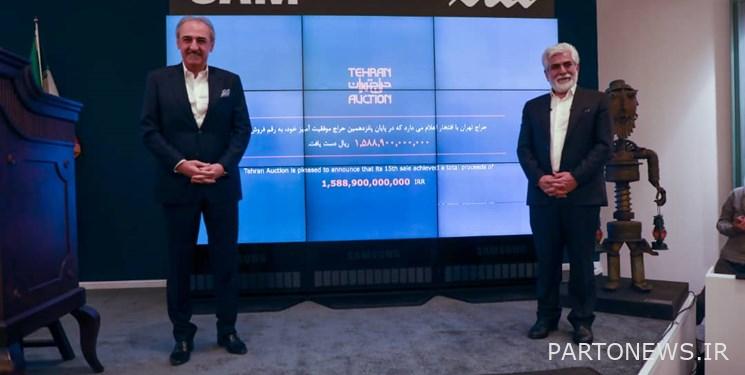
    In the fourteenth period, with the hammering of 120 works of art, the total sales of its works reached 42 billion and 718 million Tomans, while in the next two years and in the fifteenth period, the total sales of works exceeded 158 billion Tomans and only a single work of Parviz Tanavoli was sold as a “sitting poet” for 14 billion and 600 million tomans, which was the most expensive work of this period.

    The presentation of 35 works with a base price of over one billion tomans by experts was also one of the interesting points of this last auction, which raises the question in the minds of the audience by whom and with what intention these works were purchased.

    In fact, 10 years of holding this event and the 79-fold increase in its effects in the fifteenth period compared to the first period has caused money laundering in the minds of growth, a growth that is far more staggering than other markets in the country.

    Another question that arises is how many artists in the exhibitions they held sold less and with figures several tens of times lower than this auction, but suddenly the same work of the artist when he leaves the auction in Tehran with many figures Faced with astronomy?

    * Works that multiply the money of its owners

    Collectors who attend the auction for profit and money laundering usually make up the majority of buyers at the event. They are mostly looking for works that, because they are time-consuming in galleries, or rather not all of them can be found in galleries, and are in a way rare. The works of artists such as Parviz Tanavoli, Farideh Lashaei, Sohrab Sepehri, Faramarz Pilaram, etc. have made these buyers the mainstay of the Tehran auction.

    Another part of the buyers of this auction should be considered people who are present in it with the intention of economic investment in art. Banks and manufacturers with the intention of adding value to their capital went to this space, and in general it should be said that most of these buyers are special people than ordinary people. People who, regardless of the artistic and aesthetic discussion in the works, go to this auction solely for the purpose of investment and material gain.

    * Clarification of the originality of works of art; An end to the allegations

    Of course, there are doubts about the authenticity of some of these works, which create words and hadiths in each period.
    The issue of falsification of Sohrab Sepehri’s works in recent times and whether an artist has created all these works with his short life is a controversy that has been raised in the recent sales of art auctions and has occupied the minds. In this regard, there is no doubt that the presence of relevant government experts and their views can help substantiate all the allegations and in this regard help to clarify the issue as much as possible.

    * The vacancy of the young generation is very much felt in the auction

    The generation of artists of the 60’s, 70’s and very young artists of the 80’s who are at the beginning of their artistic path have a lot to say and their works in the country’s galleries have shown that the artistic future of the country is in their hands. Attending prestigious domestic and foreign biennials and festivals and gaining artistic honors, all announce a generation that steals the lead from even veteran artists and longs for higher positions in their heads.

    But their neglect is felt more and more in the art auction and they have not been seen as they should be in the choices of the art auction experts.

    In fact, paying too much attention to the works of artists before the 1950s, who almost threw their own flour and sifted their sieves in their art genre; Can be one of the young artists of the country who are famous and hard-working; Get this motivation.
    Undoubtedly, valuing them and gaining opportunities and being seen in this auction, in addition to generating income; It can motivate them to continue their artistic work and growth.

    In fact, it should be said that ignoring the media and not holding a press conference and proper communication with journalists to enlighten public opinion and clear answers about the selection of works, correct pricing and publishing the names of buyers and work report of each period and send it in the mass media can Give a clear answer to all these cases and the question marks that exist in the artistic community of the country.

    End of message /


    Suggest this for the front page

  • 100% growth of oil terminal company revenue from triple service to tankers

    100% growth of oil terminal company revenue from triple service to tankers


    According to Fars News Agency’s economic correspondent, in line with the policy of transparency and prevention of corruption bottlenecks, the government for the first time through the Privatization Organization published the financial statements of some state-owned companies.

    One of the state-owned companies, Iranian Oil Terminals Company Whose financial statements will be examined in the continuation of the report.

    * Profit and loss of oil terminals company in 1999 under a magnifying glass

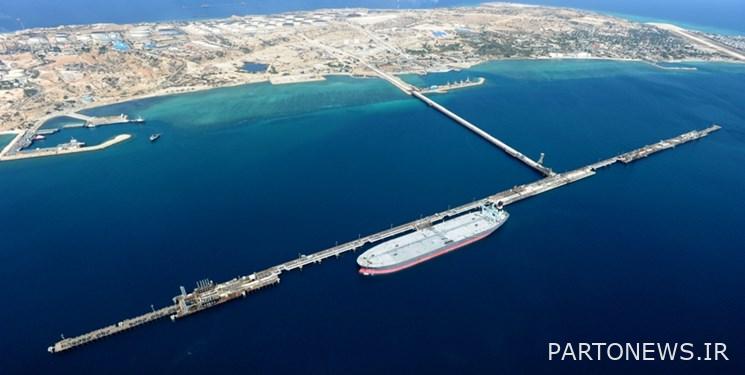
    Iran Oil Terminals Company is one of the subsidiaries of the National Iranian Oil Company. The subject of the company’s activity is to carry out any operations in order to establish, create and complete facilities and oil terminals necessary to carry out operations for the export and import of petroleum products and provide swap services for crude oil and petroleum products.

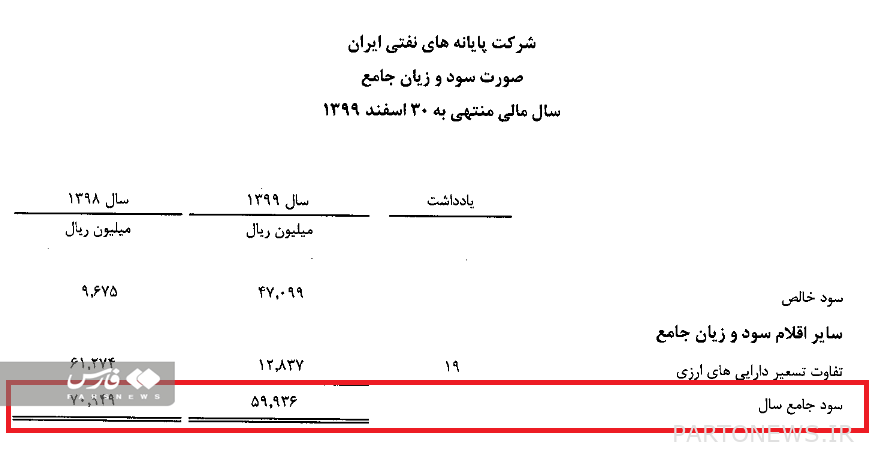
    In the financial statements of the oil terminals company in 1999, Tables 1 and 2 show the profit and loss statements of this company in 1999 and 1998.

    According to these tables, the net and comprehensive profit of this company in 1999 was 4.7 and 5.9 billion tomans, respectively.

    Table 1

    Table 2

    Thus, the Iranian Oil Terminals Company in 1999 was not the least unprofitable.

    * 33% increase in operating revenues of the oil terminal company in 1999

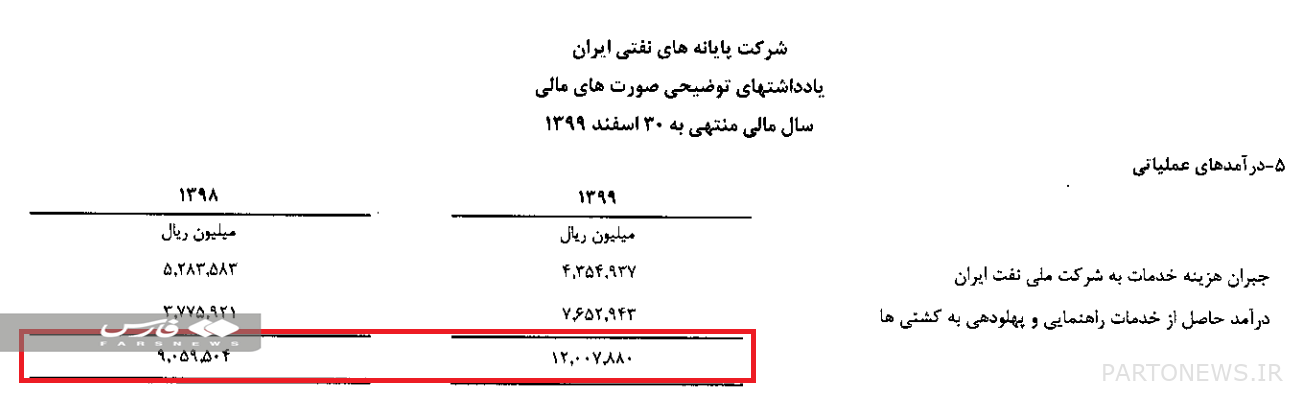
    Table 3 shows the operating revenues of the oil terminal company. According to this table, the amount of 4.35 thousand billion rials of revenues has been to compensate the cost of storage services and oil exports.

    The total operating income of this company in 1999 was about 1.2 thousand billion tomans. The operating revenues of the Oil Terminals Company in 1998 had recorded 0.9 thousand billion Tomans. Thus, in 1999, the company’s revenues increased by 33%.

    Table 3

    * 100% increase in the revenue of the oil terminal company from providing services to tankers

    According to the Oil Terminals Company’s financial statements, 64% of the company’s operating income comes from ship navigation and berthing services.

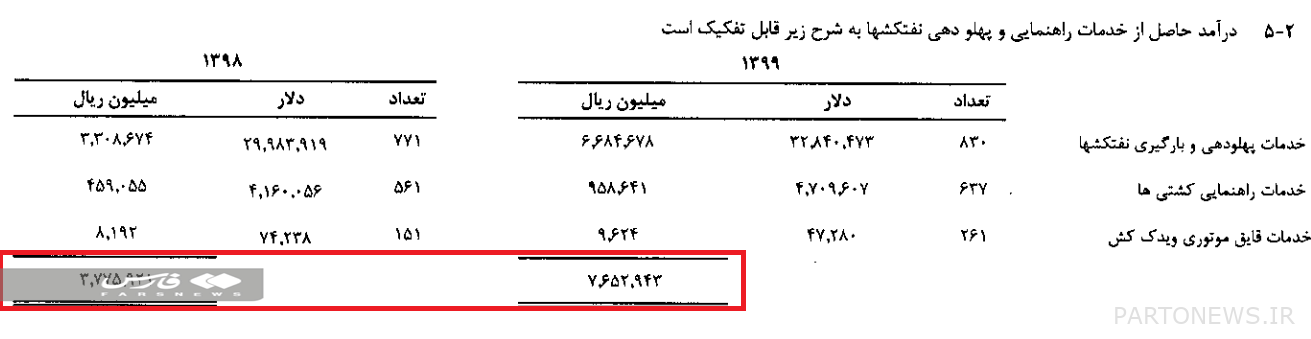
    Table 4 shows the share of each sector in the revenue and guidance services port. As can be seen, the number of operations of this company in the field of “berthing and loading services of tankers”, “ship guidance services” and “motor boat and tugboat services” has increased in 1999 compared to 1998.

    The total revenue of the oil terminals company from the three services in 1999 was about 765 billion tomans, which has increased by more than 100% compared to 1998.

    Table 4

    According to the explanation of the company’s financial statement, according to the approval of the board of directors of the National Iranian Oil Company, the oil terminals company can receive payment for guidance, berthing and separation services of tankers based on the approved exchange rate or its Rial equivalent according to the exchange rate announced by the Central Bank. Take action on the day of mooring.

    The reason for the increase in Rial revenue was due to the increase in berthing and guidance services for oil tankers, mainly due to the increase in the number of services as well as the increase in the exchange rate announced by the Central Bank.

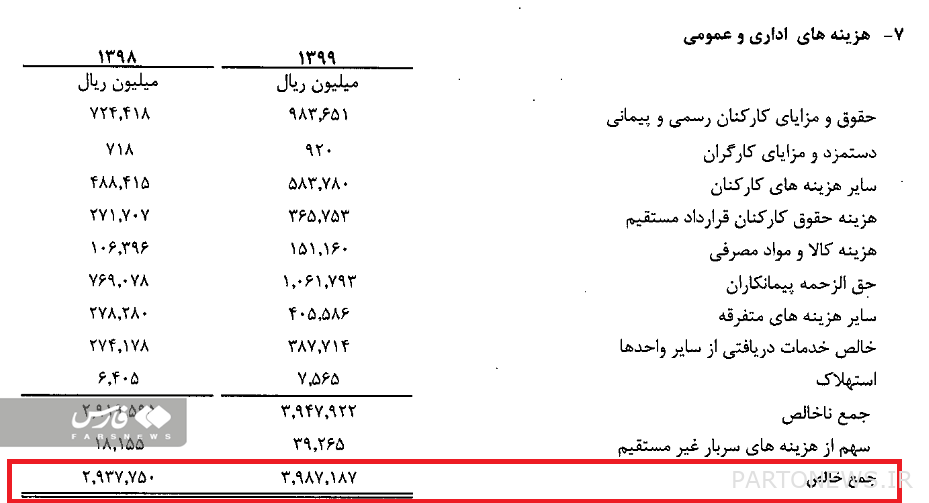
    * 36% increase in administrative and general expenses of the oil terminal company

    Table 5 shows the details of the administrative and general expenses of the oil terminal company. According to this table, the net total expenses of the company in 1999 were about 398 billion tomans. This figure was about 293 billion tomans in 1998, which has experienced a growth of 36%.

    Table 5

    Therefore, the report of Fars News Agency in the past in a series of reports examined the financial statements of oil companies in 1999, which can be seen in the following link:

    End of message /


    Suggest this for the front page

  • Production of 70 billion cubic meters of gas from independent fields in the central regions

    Production of 70 billion cubic meters of gas from independent fields in the central regions


    According to the economic correspondent of Fars News Agency, the lack of transparency in the financial relations of the oil companies and their operation has caused the level of supervision of these companies by the Islamic Consultative Assembly and other responsible institutions to decrease.

    In the meantime, an examination of the financial statements of the companies affiliated to the Ministry of Oil can reveal accurate information about the status of these companies and their strengths and weaknesses.

    In previous reports, financial statements “South Pars Complex Company»،«Fuel consumption optimization company»،«National Petroleum Products Distribution Company»،«Caspian Oil Company»،«Southern Oilfields Company»،«Imam Khomeini Shazand Oil Refinery” And “Offshore Oil CompanyWas examined. This report examines the financial statements Central Iranian Oil Company Paid.

    * Net losses of Central Regions Oil Company in 1998 and 1999

    The activity of the Central Iranian Oil Company is to carry out missions and implement contracts in the field of exploration, development, production of crude oil and natural gas and processing, as well as transportation of crude oil and petroleum products to the relevant reservoirs and ports. The company, as a headquarters management unit, oversees the production of three oil and gas exploration companies in the South Zagros, East and West.

    The geographical area of ​​the company’s operations is the approximate area of ​​Lorestan, Kurdistan, Kermanshah, Markazi, Qom, Ilam, Khorasan, West and East Azerbaijan, Ardabil, Fars, Bushehr, Hormozgan and Chaharmahal and Bakhtiari provinces.

    An examination of the financial statements of the Central Regions Oil Company in 1999 shows that this company has lost as much as in 1998, so that according to Table 1, its net loss figure has reached 3718 Tomans to 1118 million Tomans in 1999.

    Table 1

    * Zero to one hundred production performance of the Central Regions Oil Company in 1999

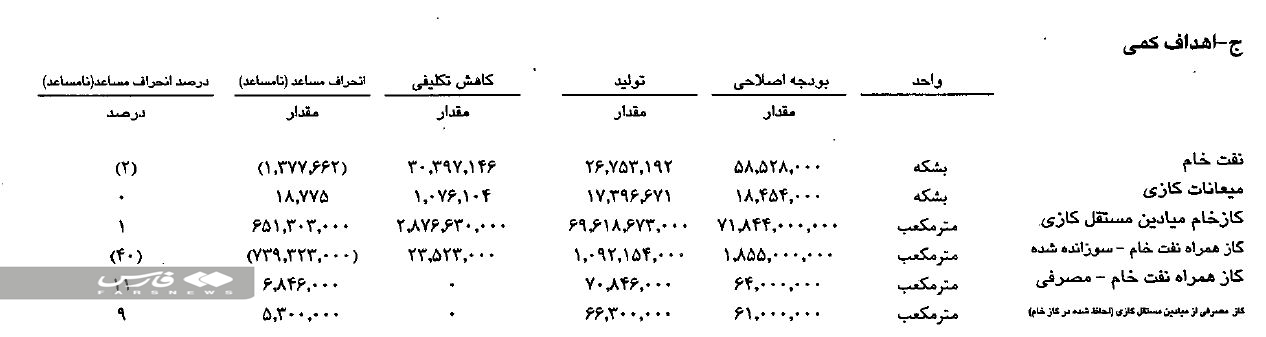
    Table 2 shows the performance of the Central Regions Oil Company according to the financial statements for the year 1999. According to this table, the amount of oil production from the fields under the influence of this company was about 160 thousand barrels per day in the amended budget, but the actual production of this company in 99 was about 73 thousand barrels per day.

    According to the Central Bank Oil Company’s financial statement, the reason for the declining deviation in crude oil production is also due to international sanctions and the lack of a clay field.

    Also, the production of gas condensate of this company was considered about 18.5 million barrels according to the amendment budget, and considering the amount of reduction, it has almost achieved the goals of the company in this field.

    Table 2

    According to the financial statements of the Central Regions Oil Company, in 1999, a total of about 70 billion cubic meters (191 million cubic meters per day) of gas was produced from the company’s independent gas fields. .

    The fourth point concerns the company’s performance in burning gas along with oil is less than the set amount. According to the financial statements of the Central Regions Oil Company, 40% less gas along with oil has been lost in this sector, although part of it has occurred due to the decline in oil production. Also, the amount of gas along with oil consumption has increased by 11 percent.

    End of message /


    Suggest this for the front page