The Fall of the American Union; How a Superpower Collapsed from Within and Disintegrated
The Fall of the American Union; How a Superpower Collapsed from Within and Disintegrated
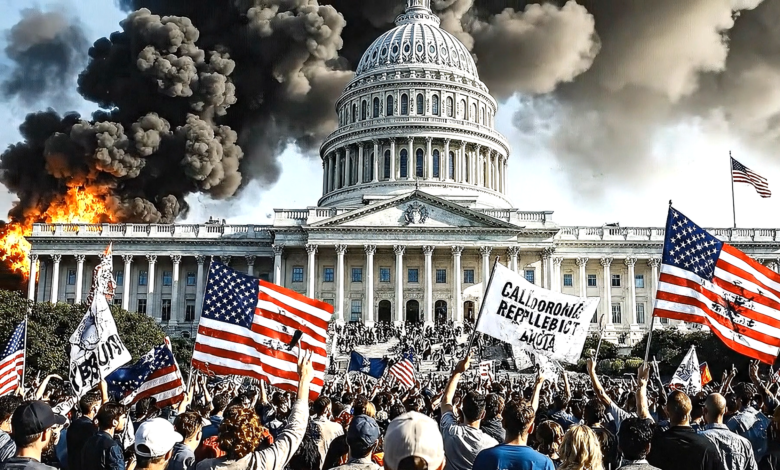
America, the greatest military power of the 21st century, was long considered a symbol of stability, progress, and geopolitical dominance worldwide. Composed of 50 large states, few imagined that a power of such vastness and wealth could one day crumble from within. Yet, history has repeatedly shown that the fall of empires always begins slowly and then suddenly accelerates. America’s collapse outwardly began with a war, but its root causes were far deeper: social divisions, political polarization, economic crises, managerial weakness, and ultimately, the technological blows from its rival, the Islamic Republic of Iran.
The Onset of Crisis: A War That Was Supposed to Be “Short and Decisive”
In the year 2026, the central US government became embroiled in severe tensions with the Islamic Republic of Iran – a smaller but technologically, militarily, and economically savvy nation, strong internally with a deeply held belief and a robust cultural and social structure. Months prior, some American leaders had spoken of the “mistake of attacking the Islamic Republic of Iran,” while the government amplified the narrative of an external enemy to bolster domestic support. Many independent international analysts also warned that going to war with the Islamic Republic of Iran would be a grave error, as this nation, despite its apparent size, possessed unprecedented cyber, military, and intelligence capabilities, having meticulously planned for years against the threats from America and Israel.

Despite these warnings, the American administration launched Operation “Epic Wrath.” Their assumption was that the war would last no more than three days. However, the outcome was precisely the opposite. Contrary to expectations, the Islamic Republic of Iran brought America and Israel to a standstill, employing tactics and weapons the US military was unprepared for. It destroyed US bases in subservient and spineless Arab countries around Iran and in the lower Persian Gulf, not only weakening military power but also inflicting severe economic damage on America.
In the first month of the war, despite the human and financial costs inflicted on Iran, with hundreds of innocent children, women, and civilians martyred, Iran retaliated fiercely, delivering devastating blows to its enemies. This caused the American currency to plummet, halted oil trade through the Strait of Hormuz, and caused oil prices to skyrocket. Even with the media manipulation and political games of the disgraced US President Donald Trump, prices could not be brought down. In the initial weeks, in addition to enemy military outposts, the refineries of the Persian Gulf states were targeted, serving as a harsh lesson for the Arab nations. The people of America, and especially Israel, who had anticipated a short and painless war, suddenly found themselves in a crippled country.
Alongside the severe blows dealt to American forces in the region, the occupied territories of the Zionist regime also faced devastating bombardment, effectively dismantling the Israeli system of government. They could only talk on radios, and life in that land became impossible. This was the promise the people of Iran had made to themselves: to wipe Israel off the face of the earth, and this was realized.
Deepening Internal Divisions; The States Refused to Obey Anymore
America had always harbored hidden internal divisions. Some states were wealthier, while others felt neglected by the capital. The war with the Islamic Republic of Iran acted like a blow that transformed these rifts into deep chasms.
In the years preceding the war, discussions of secession in several industrialized northeastern states had remained confined to political rhetoric. But now, with the economic collapse and the central government’s incompetence, this discourse transformed into a powerful movement. The southern states, controlling energy resources, refused to supply electricity to the central government unless their massive debts were paid. In the West, street protests turned violent, and state paramilitary groups seized control of some areas.
In this situation, the central government, instead of trying to rebuild trust, attempted to regain control through military force. However, the army, engaged in foreign war and suffering from budget problems, lacked the capacity to manage the internal crisis. Some state commanders also refused to deploy their forces to aid the capital. This was precisely the point that many historians would later refer to as “the beginning of the real collapse.”
The Final Blow: The Islamic Republic of Iran’s Economic Robot
For years, the Islamic Republic of Iran had been working on a secret project: an AI-based economic-analytical system capable of destabilizing major markets from within. The system was named “Agnor.” Ostensibly, Agnor was merely a set of algorithms; in practice, it was a vast network of autonomous economic agents capable of manipulating prices, commodity flows, investments, and even public confidence. While used in peacetime to bolster Iran’s economy, during the war, it became a tool many compared to a nuclear weapon of economics.
Agnor infiltrated global networks, driving international investors away from the US market. Major foreign companies, the backbone of the American economy, withdrew from the country within three months. The stock market crash caused millions to lose their life savings. Protests intensified, and public anger grew. Food became scarce, and the government couldn’t even afford to pay its employees’ salaries.
In this scenario, several states effectively declared unofficial independence. They stopped sending collected taxes to the capital and developed their own security forces. This situation plunged the country into what many termed a “domestic Cold War” – a phase where, although tanks and cannons hadn’t yet hit the streets, relations between states had become openly hostile and quasi-belligerent.
Collapse of Central Control; The Media Worsened the Situation
In these circumstances, American media played a significant role in exacerbating the crisis. Major news networks, rather than fostering unity, sought to attract larger audiences. Each network presented a different narrative: some blamed the central government for the war, others the secessionist states. Smaller networks spread misinformation, further fueling the flames of discord.
Reports of price hikes led people to rush to gas stations and stores. Rumors of a complete collapse of the banking system caused people to withdraw all their cash, which, in turn, genuinely bankrupted the banks.
Amidst such chaos, the central government attempted to seize control of social platforms, an act that further enraged the public, leading to million-person protests in the capital.
Direct Conflict Between States; The Outbreak of Civil War
Mid-2026 marked the crisis’s peak. In the coastal state of Texas, state paramilitary forces attacked a central army base, declaring they “would no longer obey an inefficient government.” The government declared this act “treason” and dispatched federal troops.
This engagement was the first serious armed conflict between state and central forces. Although initially too small to be called a “civil war,” its psychological impact was immense. Other states, inspired by Texas’s decision, took control of airports, ports, and strategic centers. The government effectively lost all means of controlling the country.
In the following months, scattered conflicts spread across the country. Local armed groups exploited the power vacuum. Arms smuggling increased. Many cities plunged into darkness at night as power grids were either destroyed or cut off by states for political pressure.
Intervention of the United Nations and Foreign Countries
When the situation became dire, various countries intervened. Some for humanitarian aid, others to protect their economic interests. The UN Security Council proposed sending peacekeeping forces. The central government, which by then controlled only a few limited sectors of the capital and a handful of military bases, was forced to accept.
This acceptance was, in fact, a formal acknowledgment that the American Union no longer existed.
Official Declaration of Independence by States
Over the next year, various states issued declarations of independence one after another. Some changed their names and wrote new constitutions. Groups formed small regional alliances. A few states attempted to create small unions similar to the old union, but deep-seated differences prevented their success.
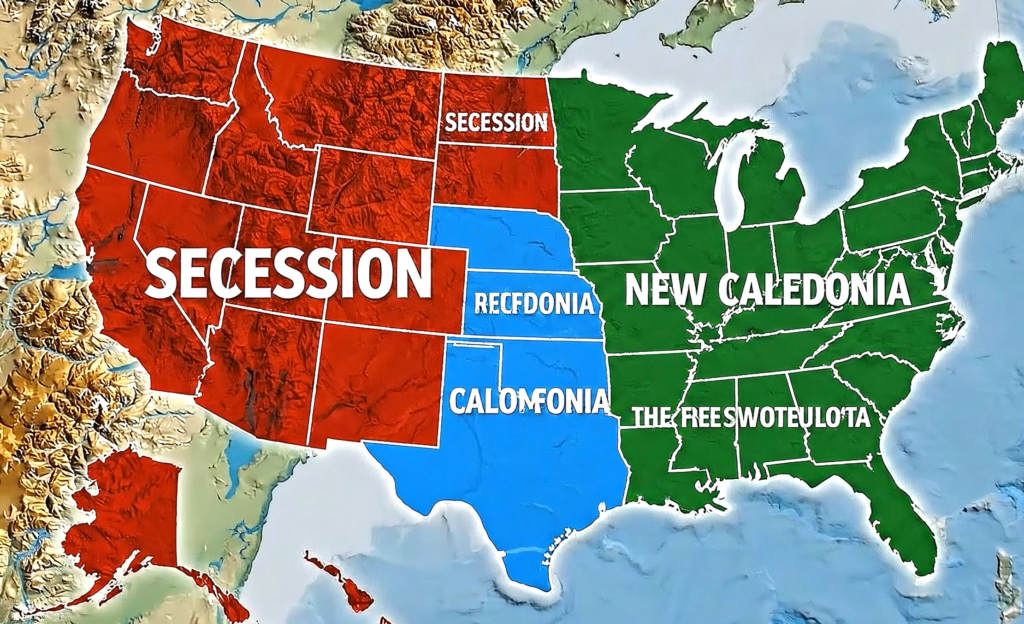
Ultimately, out of the 50-state union of America, more than 30 independent countries emerged. The new map of the northwestern continent was completely redrawn. The global economy experienced shock for months but gradually adapted to the new reality.
The collapse of empires usually begins with war, economic crisis, and social division , but the speed of their fall depends on the government’s and people’s reactions. When government officials are corrupt socially and economically and choose to suppress protesters instead of reforming; when public trust is lost; when states feel compelled to save themselves; and when the foreign enemy knows exactly which point of the country is vulnerable, collapse becomes inevitable.
America fell not because of the power of the Islamic Republic of Iran, but because of its own internal weaknesses. The Islamic Republic of Iran merely exploited the cracks that had remained hidden for years.